

 WHY ROPS AND DOES IT INCREASE SAFETY OR NOT ?
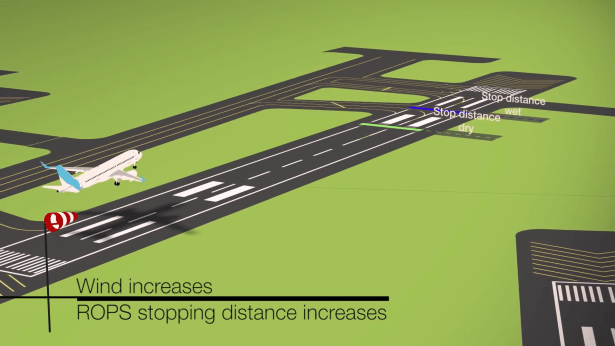
Runway overrun preventaion sytem (ROPS) is a safety enhancement function for all braking, meaning manual and auto at landing . ROPS helps the flight crew to anticipate an overrun risk at landing phase by computing in real time landing distance and comparing them to the runways length .
ARMING AND DETECTION:
- the system detection starts from 2000ft AAL
- the ROW function arms from 400ft AAL
ROPS system is divided into two sub -functions ROW and ROP :
ROW ( GO Around Minded )
- RUNWAY OVERRUN WARNING provides( in-air alerts) in case of detection of a risk of runway overrun.ROW is active until a transition from the in-air phase to the on-ground phase ( braking phase ) .
- ROW provides reversible aural and visual indication when computed, stoping distance exceeds the remainig runway length .
- in this case the flight crew should perform a GO-AROUND .
ROP ( STOP MINDED )
- RUNWAY OVERRUN PROTECTION provides( on-ground alerts )in case of detection of a risk of runway overrun . ROP is active by applying brakes .
- ROP provides aural and visual indications if the current aircraft deceleration or aircraft capability to decelerate is not sufficient to safely stop before reaching the end of the landing runway.
- in this case the flight crew should apply FULL PEDALS BRAKING AND MAX REV.
SYSTEM CRITERIA :
IN ANY FAILURE CASES AFFECTING AIRCRAFT PERFORMANCE , ROPS FUNCTION IS STILL ACTIVE AND ALERTS MUST BE FOLLOWED.
- with or without Auto pilot .
- on dry or wet runways
- whatever the braking mode
- whatever the wind and visibilty condition down to CAT IIIB .
- whatever the aircraft landing configuration , weight , CG
- ROPS does not take into account any degradation of braking capability due to a failure.
- landing runways are in the terrain or airports database .
ROPS runway detection :
The ROPS is automatically activated during the final approach until the end of braking
this function is based on auto detection of the landing runway from ROPS database and aircraft position . at any time if is there a runways change the new runway becomes the new protected runway.
In-air alerts ROW function :
ROW continuously computes in real-time two predicted minimal landing distance one for the dry and one for the wet runway, corresponding to Factored in flight landing distancs FLD using max manual braking .
Row monitors compute the dry and wet minimal landing distance respecting the runway end, and in case the estimated stoping distance exceeds the remaining runway length, the ROW alert is triggered.
ROW distance computations are based on FLD which includes an in-air distance from 50ft to touch down and an on-ground distance ( from touch down to stop ) , ROW uses flight parameters from :
- True airspeed
- ground speed
- Aircraft weight
- total air teemperature and QNH
- landing configuration , longitudinal position , radio altitude , runway slope .
- when the glideslope is below 4.5 the system assumes a height of 50ft at runway threshold , if the glide slope is above 4.5 the system will longitudinally translate the point at which the aircraft will reach the 50ft.
On-ground ROP function :
this function is activated when brakes are applied to decelerate below 30KTS . ROP permanently computes in real time the estimated braking distance to stop .
ROP monitors the position of the estimated stopping point considering current position, speed deceleration with respect to runway end .
ROP Alerts inhibition :
- Go-Around is detected
- Aircraft decelerates below 30kts
- Aircraft is vacating the runway
BY CAPTAIN / AHMED SHEBL
A320/321/330/300/310 captain and FAA flight instructor , MBA Aviation management

Discover more from Egyptianaviators
Subscribe to get the latest posts sent to your email.
 Egyptianaviators